

市场资讯及洞察
.jpg)
自GPT点燃人工智能产业浪潮以来,全球资本市场的叙事重心几经转移。从最初的核心算力芯片,到高带宽存储,再到电力与散热基础设施,每一个阶段都有相应的硬件赛道成为市场焦点。而当前,聚光灯正照向一个曾经相对边缘的环节——光通信与光模块。而这轮的炒作也是AI硬件演进至2026年后物理极限倒逼的必然结果。理解这一逻辑,有助于把握当前AI产业链的核心瓶颈所在。
一、算力瓶颈的递进:从“算力荒”到“互联墙”
回顾AI硬件投资的脉络,每一次瓶颈的转移都催生出一批核心受益标的。
2023年:算力荒。 大模型密集发布阶段,最稀缺的资源是算力芯片。英伟达的GPU与掌握CoWoS先进封装产能的台积电,成为产业链的绝对核心。
2024年:内存墙与电力墙。 算力提升后,数据传输速度成为新的制约因素;同时,大规模集群运行带来显著的电力负荷压力。HBM(如SK海力士)和液冷温控(如维谛技术)解决方案因此迎来高速增长。
2025-2026年:互联墙。 这是当前阶段的核心瓶颈。AI算力集群已从万卡级别扩张至十万卡级别,GPU之间的数据交换量呈指数级增长。网络连接一旦拥堵,庞大的算力投资将无法有效释放。如何实现GPU之间的极速互联,便成为光通信产业链成为超级主线的底层逻辑。
二、光模块的核心驱动力:从“按年迭代”到“按月推进”
在超算中心内部,光模块承担着连接GPU的“数据通道”功能。其爆发式增长可归纳为三大核心驱动力:
(一)铜缆的物理极限。 在传统的短距离传输中,铜缆尚可胜任。但在当前800G甚至1.6T的超高传输速率下,铜缆的有效传输距离受到严格限制。在长距高速互联场景中,“光进铜退”已成为不可逆转的技术方向。需要说明的是,在机架内极短距离互联场景下,铜缆方案依然具备成本和低功耗优势,如英伟达GB200 NVL72即采用高速铜缆背板互联方案,铜缆连接数量高达5,184根。不过,随着GPU集群规模的持续扩大,铜缆在高速条件下的传输距离限制日益凸显,光通信方案的重要性正在快速提升。
(二)高速迭代与市场规模跃升。 在传统通信时代,光模块速率从100G提升至400G往往耗时数年。而在AI时代,云厂商直接以订单推动交付节奏。据Lightcounting测算,2026年全球光模块数据通市场规模预计达228亿美元,2026至2030年复合增速约为20%。中金公司指出,2026年全球光模块已进入800G全面普及、1.6T规模商用阶段,头部厂商中际旭创与新易盛已启动1.6T光模块的小批量出货。高端新品订单消化速度较快,叠加硅光方案带来的BOM成本下降,推动相关企业毛利率稳中有升。
(三)硅光子与CPO:技术迭代的下一阶段。 为满足高带宽、低功耗的系统需求,硅光子技术和光电共封装方案正成为产业格局重构的重要方向。银河证券数据显示,2026年800G光模块中硅光方案占比已超过50%,而在1.6T光模块中占比高达70%—80%。传统EML光芯片路线产能集中于海外,受限于磷化铟材料,2026年供给缺口较大,硅光方案成为缓解供应链压力的关键路径。与此同时,中金公司认为CPO已成为推动产业链新一轮升级的核心变量。
三、产业链格局:核心环节的定价权分布
在美股、A股与港股市场中,光通信产业链涉及多个细分环节,掌握核心定价权的公司各有侧重。
(一)美股:底层芯片与关键元器件的供应方
博通(Broadcom -AVGO)。 博通是光模块中DSP(数字信号处理器)芯片的核心供应商之一。高端DSP赛道呈现博通与Marvell双寡头垄断格局,双方凭借深厚的SerDes IP积累和PAM4编解码算法,几乎垄断了头部云厂商的1.6T DSP供应份额。1.6T主流方案中博通200G DSP表现较为突出,其400G DSP已发布上市,技术优势明显。但需注意,DSP先进制程芯片高度依赖台积电先进封装产能,台积电的产能排期直接影响高速光模块的放量节奏。
迈威尔科技(Marvell -MRVL)。 Marvell通过收购Inphi进入DSP市场,是博通在这一领域的主要竞争对手。在1.6T DSP供应格局中,Marvell与博通共同构成双寡头垄断。
Astera Labs(ALAB)。 该公司专注于PCIe Retimer芯片,解决单台服务器内部GPU与CPU之间的数据拥堵问题。其Aries PCIe重定时器产品线已被整合进英伟达Hopper平台,服务于主要美国超大规模数据中心客户。
(二)A股:封装与量产能力的集中地
中际旭创(300308.SZ)。 中际旭创是全球光模块领域的龙头供应商,其核心竞争优势在于新品导入能力和量产良率控制。从产业链动态来看,英伟达、谷歌、微软等全球顶级科技公司均在光通信领域展开积极布局,中际旭创作为核心供应商深度受益于这一趋势。公司800G光模块产品市占率连续两年位居全球第一,硅光技术的渗透率已超过一半。
天孚通信(300394.SZ)。 天孚通信在光器件领域拥有领先的精密封装和集成能力,是全球光器件行业的重要供应商之一。公司1.6T相关光引擎业务持续向好,已实现1.6T光引擎的规模量产。在前沿技术领域,公司前瞻布局CPO配套光器件,储备有高密度多通道FAU、ELS外置光源模组等核心产品,并持续布局硅光等下一代技术路线。
新易盛(300502.SZ)。 新易盛是光模块领域的另一家核心供应商,已具备800G及以上光模块的规模化量产能力,并成功批量交付最新一代1.6T产品。公司正积极推进3.2T、6.4T及12.8T等更高速率产品的研发。
(三)港股和相关企业
鸿腾精密(06088.HK)。 鸿腾精密业务中高速铜缆背板连接方案是机柜内短距离互联的有效路径之一。其增长受益于算力集群内部互联需求,但在光通信核心产品领域布局相对有限,与A股光模块龙头公司的主体业务存在差异。
长光华芯、索尔思光电等。 在EML光芯片领域,国内光芯片企业正在加速突围。长光华芯、索尔思光电具备IDM能力,正快速推进高端EML的送样与量产,成为填补海外供给缺口的重要力量。
四、展望:光通信之后的市场焦点
当光模块环节的认知趋于成熟,AI硬件演进的下一阶段或将引领资本市场的新一轮方向
端侧推理芯片:大模型推理请求若全部依赖云端处理,网络延迟与电力成本将面临较大压力。推进AI向终端迁移、实现本地推理已成为产业共识。端侧推理芯片有望迎来规模化落地的关键窗口期。
先进封装基板: 当前AI芯片封装面积不断扩大、功能复杂度持续提升,已逐步逼近有机基板的物理极限。玻璃基板具备低热膨胀系数、高平整度、低翘曲、高密度布线等优势,有望成为先进封装的下一个关键材料,延续封装密度和集成规模的进一步提升。从技术进展看,英特尔于2026年CES发布了首款采用玻璃核心基板进行量产的Xeon 6+处理器,苹果也已开始测试先进玻璃基板用于AI服务器芯片。台积电正加速推进玻璃基板与FOPLP融合方案,并计划于2026年建成迷你产线。
具身智能硬件: 大模型若缺乏物理交互能力,将无法完全作用于物理世界。当AI开始尝试与环境发生交互时,高精度六维力矩传感器、无框力矩电机、行星滚柱丝杠等机器人核心零部件也将随之迎来大规模资本涌入的重要拐点。
结语
从算力芯片到存储,从散热到互联,AI硬件瓶颈的每一次转移都带来新的投资主线。光通信与光模块作为当前“互联墙”环节的核心受益领域,其产业景气仍处于上行通道。中长期来看,端侧推理、先进封装与具身智能硬件亦是值得关注的方向。


The EURUSD pair has been navigating challenging waters in recent weeks, experiencing a decline of more than 5% since mid-July. This decline has primarily been due to the USD's strength, as the Federal Reserve remains firm in its commitment to maintaining higher interest rates for longer to bring down inflation. Last week marked a critical turning point for EURUSD as it breached a crucial trend level.
The ascending channel that had been in place since early 2023 was broken, resulting in a swift price decline to around 1.07. Presently, the pair is sitting precariously on an important horizontal support level. The significance of this support level cannot be overstated.
Failure to hold at this level could lead to further downward movement, with the next support zone around the 1.05 mark. This impending test of support comes at a pivotal moment as the market eagerly await the release of the US Consumer Price Index (CPI) data later this week. The upcoming CPI data will be the main event for USD traders this week.
A decline in inflation could potentially soften the USD, suggesting that the Fed might consider an earlier-than-expected rate cut. On the other hand, if inflation exceeds analyst estimates, it may bolster the USD's strength, potentially causing the EURUSD pair to breach its current support level and head towards lower levels. As we approach the release of the CPI data, all eyes are on this key economic indicator.
Its outcome will undoubtedly serve as a pivotal driver of direction for the EURUSD pair this week.

EU and UK indices are looking to open slightly stronger despite a weak lead from the Asian session. Aussie and Asian indices finish in the red after US-China tech-related frictions and disappointing Japanese GDP revisions weighed on risk sentiment. Asian session wrap - FX Markets The USD was softer with DXY retreating from extreme RSI overbought levels to push below the key 105.00 level.
Dovish commentary from the Fed’s Logan ahead of the Fed blackout window and strength in the Dollars major counterparts outweighing the sour risk sentiment which would normally see the Dollar benefit from haven flows. EUR bounced back after a sell-off on Yesterday’s dismal German data. EURUSD pushing back above the 1.0700 level after finding support at the June lows.
USDJPY was choppy with early drop due to the risk-off mood and MoF jawboning saw the pair test the S/R level at 146.63 before bouncing back as the Asian session progressed. Japanese Finance Minister Suzuki stating in comments that rapid FX moves are undesirable and warned the Japanese MoF won't rule out any options (intervention?) AUDUSD rallied to test the key 0.6400 S/R level, despite the risk-off tone and recent commodity pressure. A weaker USD and some technical support from the daily trendline seeming to be the key drivers.
Looking ahead, the main risk events data wise will be Canadian jobs figures later today and Chinese CPI released on Saturday.
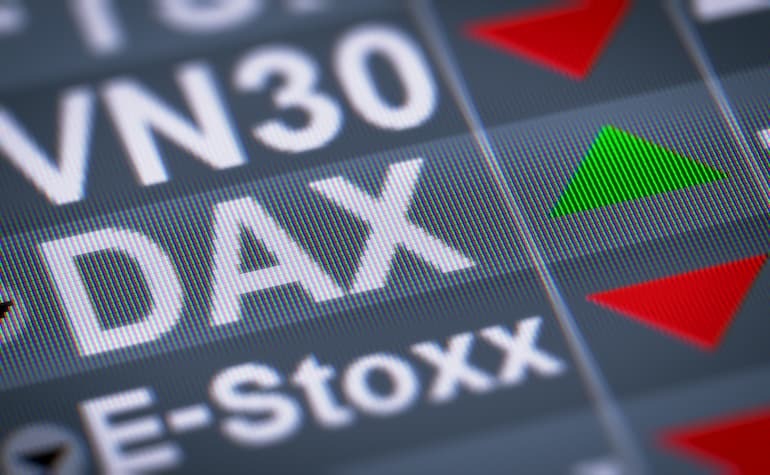
The DAX cooled off in yesterday’s session off the back of higher-than-expected German inflation data. With analysis expecting the Year-on-Year rate to fall to 6%, the actual number was higher at 6.2%. This has raised some concerns over the fight against inflation in Germany, putting an end to the three-day green streak for the DAX.
Technically, price bounced nicely off the support zone around 15,500-15,600. This level has acted as both a key area of resistance and support in the past 6 months. Since the first breakout above that zone in March, price has been ranging sideways ever since.
Multiple attempts to break and hold above the January 2022 high have failed, and the recent sell-off coincided nicely at the mid-range level. From a purely support and resistance technical view, there are two scenarios that could occur. The first would be a fall back down to the key support level around 15,600.
The second could be a positive catalyst news even that kicks price through the mid-range resistance level and back up towards the January 2022 high for a 4th attempt at breaking through. Since the recent low 2 weeks ago, the price action formed a more bullish market structure on the lower timeframes. We’ve seen a clean higher high and higher low.
While this bullish structure holds, bulls could remain in control.

In June, the Reserve Bank of Australia (RBA) surprised markets with a decision to hike rates by 25bps, taking the Australian cash rate to 4.10%. This was decided on the basis that further increases were required to provide greater confidence that inflation would return to the target range within a reasonable timeframe. This decision led to the AUDUSD climbing steadily from the 0.6650 price level up toward the 0.69 round number resistance area.
Currently, the AUDUSD is trading along the 0.6670 price level, just below the 23.60% Fibonacci retracement level, in the lead-up to the RBA decision on 4th July. While markets anticipate that the RBA could hold rates at 4.10%, given that the consumer price index (CPI) has fallen significantly from 6.8% to 5.6%, another surprise hike from the RBA could still be possible as inflation is still well above the target range. As the AUDUSD found relative support along the 0.6595 price level and with the Relative Strength Index (RSI) trending to the upside, a decision from the RBA to hike rates to 4.35% could lead the AUDUSD to climb steadily toward the immediate resistance level of 0.69.
Watch for the price to break above the 0.67 round number level, to signal a confirmation of the upside, with the 0.68 price level coinciding with the 61.8% Fibonacci retracement level providing brief resistance on the path up to the 0.69 resistance area.
Since March 2023, the GBPUSD had been trading higher as the US Federal Reserve and the Bank of England (BoE) maintained along their path to continue raising rates, as they battled to bring inflation down to their 2-3% target level. As the DXY recovered in strength, this led the GBPUSD to reverse from the high of 1.3130, trading down toward the lower bound of the bullish channel, along the 1.28 price level. Although the Consumer Price Index (CPI) data in July had a signaled a slowdown of inflation growth to 7.9%, this is still well above the BoE’s target level and significantly higher, compared to the other major economies.
At the upcoming meeting on 3rd August, the BoE is expected to raise rates by 25bps, a fourteenth successive tightening, taking rates to 5.25% the highest since December 2007. However, it cannot be ruled out that the BoE could further surprise markets with a 50bps rate hike, similar to its actions in June. At the upcoming meeting on 3rd August, the BoE is expected to raise rates by 25bps, a fourteenth successive tightening, taking rates to 5.25% the highest since December 2007.
However, it cannot be ruled out that the BoE could further surprise markets with a 50bps rate hike, similar to its actions in June.
Australian CPI figures today see a rapid cooling in Aussie inflation, coming in at 5.6% y/y against an expected 6.1% and a big drop from April’s 6.8% shock to the upside. This saw a rapid re-pricing of rate hike odds at the next RBA meeting on July 4 th, with interbank futures signaling odds have dropped to 17% of a 25bp move, from 25% pre-CPI. Unsurprisingly a rapid fall in AUDUSD was also a consequence of this market repricing, after finding some support at the 50% retracement level of the June low to highs this week, AUDUSD pushed lower to test the 618% Fibonacci level before finding some buyers.
These two levels will be worth watching, whether AUDUSD can regain and again find support at the 50% retracement or that level now becomes resistance and puts the 61.8% retracement level in danger of giving way.