With AI capital expenditure under scrutiny and central bank settings on edge, track this week's primary market drivers and technical levels for Nvidia, Woodside, CBA, Microsoft and GameStop.
The CBOE Volatility Index (VIX) is waking up, and it is not doing so in a vacuum. Connect the dots across three major pressure points and traders will find a changing US Federal Reserve policy stance under Chairman Kevin Warsh, Brent crude holding near US$90/bbl on Middle East shipping friction, and institutional investors demanding actual proof of return on investment (ROI) for multi-billion-dollar artificial intelligence (AI) infrastructure spending.
When those three forces collide at once, the market stops trading on vague stories and starts demanding mathematical accountability. For active contract for difference (CFD) traders operating across long or short positions, this environment creates key technical watchpoints. Below is a weekly watchlist connecting macro drivers, catalyst timing, and cross-asset monitoring factors.
The five stocks to watch
Here is how five central companies sit right at the intersection of Big Tech infrastructure spending, energy market volatility, domestic interest rate settings, and retail market liquidity.
Nvidia Corp.
The macro theme: The AI infrastructure reality check. Look at the math behind the AI boom. Nvidia remains the central engine of global tech volatility, but the market's focus has fundamentally shifted.
The core question is no longer whether Nvidia can build faster hardware, but whether cloud hyperscalers can justify the massive capital expenditure (CapEx) required to buy it.
If cloud providers signal any moderation in 2027 infrastructure budgets during this week's call, high-multiple tech valuations could face immediate re-ratings.
Thursday, 27 August at 7:00 AM AEST (Wednesday, 26 August, 2:00 PM PT after-market US): Nvidia Q2 FY27 financial results release and webcast.
Discount rate sensitivity: Valuations for high-growth tech equities remain sensitive to long-term discount rates, where upward pressure on 10-Year US Treasury yields toward 4.50% can compress growth multiples.
Support levels: Technical traders monitor key support thresholds if cloud CapEx guidance varies from consensus expectations during the earnings presentation.
Price range expansion: Pre-earnings options pricing and volatility expectations typically drive expanded intraday price swings across the broader semiconductor sector.
Woodside Energy Group
The macro theme: Energy inflation and half-year results. Follow the supply chain line directly from Middle East shipping corridors to Australia's primary energy producer.
With physical transit routes constrained around the Strait of Hormuz, Brent crude is testing technical resistance near US$90/bbl.
That energy backdrop makes Woodside's half-year results a critical test case: it acts as a liquid proxy for physical oil demand, where higher realised prices bolster free cash flow, but broader economic cooling could test underlying volume growth.
Tuesday, 25 August 2026: HY26 financial results lodgement, followed by Energy Information Administration (EIA) crude oil inventories data on Wednesday, 26 August at 00:30 AEST.
Price realisation: Sustained crude oil rallies above US$90/bbl generally expand free cash flow margins for unhedged producers while adding cost pressure to transport sectors.
Futures correlation: Short-term price momentum often aligns directly with daily crude oil futures spikes across regional trading sessions.
Demand cooling: Any broader macroeconomic slowdown serves as a key watchpoint for short-side technical momentum if energy demand forecasts soften.
Trade global share CFDs
Access competitive spreads and fast execution across global stock CFDs with GO Markets.
Commonwealth Bank of Australia
The macro theme: Higher for longer rate settings. Here is how domestic monetary policy connects directly to bank valuations.
Following CBA's recent FY26 full-year statutory results, market focus pivots right back to persistent Australian inflation. When Australian Consumer Price Index (CPI) data remains sticky, domestic Reserve Bank of Australia (RBA) rate-cut expectations get pushed further out into the distance.
CBA trades at premium valuation multiples; while restrictive interest rates initially expanded net interest margins (NIM), prolonged late-cycle tightness squeezes deposit competition and raises bad debt provisioning questions.
Wednesday, 26 August at 11:30 AM AEST: Australian Bureau of Statistics (ABS) Monthly CPI Indicator release.
Inflation metrics: Trimmed mean CPI holding above 3.6% tends to delay RBA rate easing, keeping domestic monetary policy restrictive for longer.
Mean reversion: Traders monitor key technical support levels for mean reversion signals if inflation prints reinforce a hawkish RBA stance.
Yield differentials: Persistent interest rate settings support AUD/USD yield differentials while placing pressure on premium banking valuation multiples.
Microsoft Corp.
The macro theme: Software monetisation and AI infrastructure. Consider how the software side of the AI trade works in practice.
Microsoft is spending billions on AI infrastructure, but Wall Street is now demanding to see the revenue side of that balance sheet.
Markets are closely tracking enterprise Copilot adoption and Azure cloud revenue growth to determine whether software margin expansion can stay ahead of rising server depreciation costs.
27 to 28 August 2026: US Jackson Hole Economic Symposium driving potential global tech sentiment shifts.
Volatility rotation: Periods of broader equity market stress (with the VIX elevating above 22.0) often trigger risk-off capital rotation out of mega-cap growth equities.
Index barometer: Microsoft serves as a primary barometer for the Nasdaq 100 index, where price action around major technical levels guides growth sentiment.
CapEx accountability: Enterprise software monetisation commentary remains the core structural metric evaluating CapEx ROI across Big Tech.
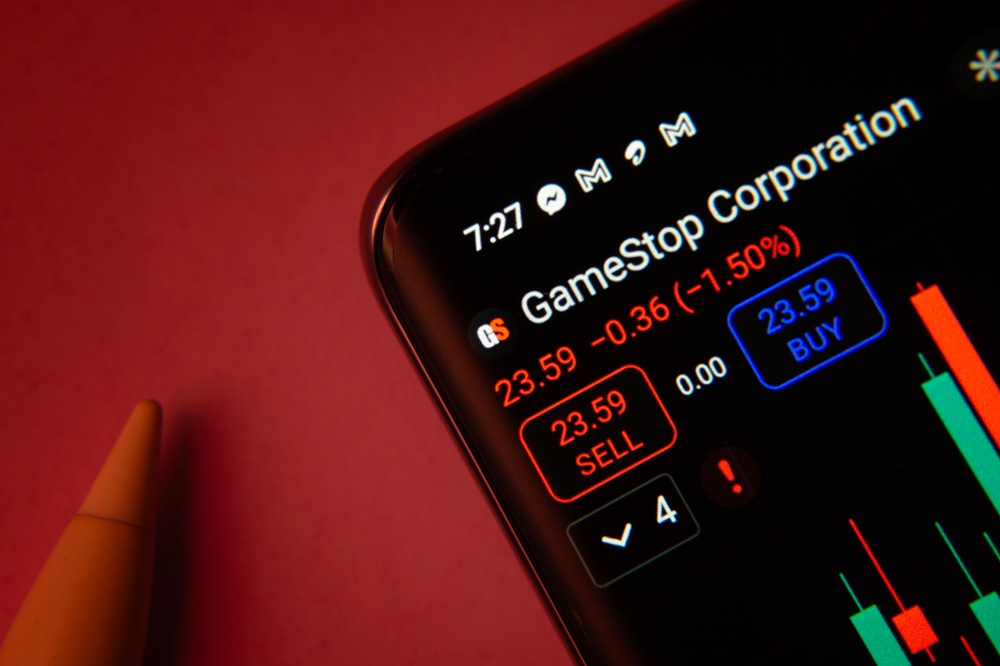
GameStop Corp.
The macro theme: Retail liquidity and volatility squeezes. Step away from fundamental valuation models entirely for this one.
GameStop continues to trade on a completely different set of rules, driven by social media sentiment, retail order flow, and options market positioning rather than traditional earnings metrics.
When market volatility picks up elsewhere, speculative retail capital can decouple from macro benchmarks and move on pure liquidity dynamics.
Saturday, 29 August at 6:00 AM AEST: Friday US options expiration and gamma positioning window (4:00 PM ET US market close).
Liquidity decoupling: Speculative retail assets frequently decouple from traditional macroeconomic benchmarks during broader market stress periods.
Gamma positioning: Localised order-flow dynamics and options market gamma positioning drive rapid technical momentum shifts.
Gap risk management: Extreme overnight gap risk and intraday volatility require strict risk parameters and volatility-adjusted position sizing.
Explore global equity CFDs
Trade long or short across global equities and indices with advanced trading platforms from GO Markets.
Reportingdates and release times are based on company investor relations calendars whereconfirmed. Where dates or times are not marked confirmed, they are GO Marketsestimates. Consensus EPS, revenue and analyst-range data are sourced fromBloomberg and Earnings Whispers, as at 09 July 2026 (AEST). Company guidance,backlog and operating metrics are sourced from the latest company filings orresults presentations, unless stated otherwise. Any scenario analysis reflectsGO Markets analysis. Figures and schedules may change without notice.
The information provided is of general nature only and does not take into account your personal objectives, financial situations or needs. Before acting on any information provided, you should consider whether the information is suitable for you and your personal circumstances and if necessary, seek appropriate professional advice. All opinions, conclusions, forecasts or recommendations are reasonably held at the time of compilation but are subject to change without notice. Past performance is not an indication of future performance. Go Markets Pty Ltd, ABN 85 081 864 039, AFSL 254963 is a CFD issuer, and trading carries significant risks and is not suitable for everyone. You do not own or have any interest in the rights to the underlying assets. You should consider the appropriateness by reviewing our TMD, FSG, PDS and other CFD legal documents to ensure you understand the risks before you invest in CFDs. These documents are available here.
Any references to Australian or international shares, sectors, indices, ETFs, crypto-related stocks or other instruments are provided for market commentary and watchlist purposes only and do not constitute a recommendation, offer or solicitation to buy, sell or hold any financial product or adopt any investment strategy. International markets may involve additional risks, including currency fluctuations, regulatory differences, market structure differences, reduced liquidity and higher volatility. Company-specific, sector-specific and macroeconomic risks may also affect performance.
Commentary on geopolitical developments, economic data, central bank decisions, earnings, policy changes and other global or financial market events is based on information available at the time of publication and may change without notice. Such events can lead to sudden market moves, price gaps, reduced liquidity, wider spreads and increased volatility, particularly in leveraged products such as CFDs. Forward-looking statements, expectations and scenario analysis are inherently uncertain and should not be relied on as guarantees of future market behaviour or outcomes.